The celebration of the birth of Christ (coinciding with the winter solstice) takes many varied forms in our country. Music, normally carols, takes on an outdoor dimension, especially in the more temperate regions such as Andalusia and Estremadura, where various groups, teams, handbell-ringers and carol-singers step out
seeking to fill their Christmas Box. In the Canary Islands, the Divinos (heavenly individuals) go carol-singing to the accompaniment of various musical instruments such as mandolins, tambourines and guitars.
On Christmas Eve (beautifully named Night of Good Tidings in Spanish), the Midnight Mass is held, so-called because it ends at midnight when, as the Holy Scriptures reflect, it was believed the cock crowed for the first time. It would then crow again at three o'clock and six o'clock in the morning. In Callosa de Segura (Alicante) carols are
sung during the Midnight Mass, dating back to the nineteenth century, whereas in Labastida (Alava) twelve shepherds with the old man (bearing a lamb in his arms), the shepherds (with the Infant Jesus) and the crook-bearer, making step, all play a part. In Lucena del Cid (Castellón), the albaes (morning chants) are sung after
the Midnight Mass, and in Vélez Blanco (Almería) the Angelus Group perform from 24th to 28th December.
Amongst the most unusual Christmas celebrations is that of the Olentzero, wherein the story of a charcoal burner who comes down from the mountains to the town to tell the good news is depicted. The character of the Olentzero or Olentzaro, to be found in various places in Navarrra and Guipuzcoa, has been preserved in Lesaca (Navarre) especially,
where he is carried shoulder-high by many different groups on Christmas Eve. The Olentzerro disappeared in Pamplona after the civil war, but reappeared, albeit somewhat moidified, in the sixties.
Nativity plays are very widespread, especially in Catalonia where they are called pessebres (crib-performance) or pastorets (shepherd-boy plays) and acted out by the local townspeople. One of the better-known pessebres takes place in Corbera de Llobregat (Barcelona), but there are many others such as those in Prat de Llobregat (Barcelona),
Isona (Lérida) and Molsosa (Lérida). Christmas celebrations in Galisteo (Cáceres) are organized by the Brotherhood of God the Child (a eucharistic play is staged). The Brothers, who number thirty-three (the age at which Christ died), go through the streets at dusk on Christmas Eve, covered by their old capes and accomplishing their
traditional penitence.
A further Christmas custom in Catalonia is that of caga tió (a sort of lucky strike game), whereby a tree-trunk with sweets and presents is installed, and then hit by children to extract hazel nuts, almonds, toffees, candied kernels and other goodies from it.
In Palma de Mallorca cathedral, preparations take the form of morning choruses and the Cant de Sa Sibilla (Hymn to St Sibly). This tradition, spread throughout the south of France, Catalonia, the Balearic Islands and Corsica, was abolished by the Trento Council. Nevertheless, the Bishop of Mallorca decided to allow it to take place, hence its preservation.
Also about this time, in Murcia, the campanas de auroras (dawn bells) group perform their ancient and sober compositions.
As to the origins of these and other celebrations commmemorating the birth of Christ, Andrés Pardo, director of the National Liturgical Secretariat, stated in an article published in the newspaper Ya in 1982 that the 25th December was chosen for Christmas for ideological reasons, the purpose being to combat the pagan sun festival, held on the same day. This feast-day
has its origins in Egypt. From Rome it moved to Africa, northern Italy and Spain at the end of the fourth century.
During the period between Christmas Day and the end of the year, several noteworthy celebrations take place, such as the meeting or clash on 28th December between bands from the hills of the province of Málaga (known in Spanish as verdiales) in the country inn of Tunel, eight kilometres away from the provincial capital. Also celebrated on this date,
which commemorates the Massacre of the Holy Innocents by Herod, were the Festival of Fools and Little Bishops, several traces of which are apparent today.
The little bishop celebration, common to many Spanish cathedrals, involved the election of one of the choir-boys as bishop. The clearest living example of this can be seen in the Sanctuary of Montserrat, where the Bisbeto (little bishop) ceremony is still held internally by the pupils. The little bishop, during his term of office, would have certain authority bestowed upon
him, and events would be given over to children's pranks, tricks and ragging. More than once the Church found these irreverent, and proggresive bans were placed on them which led slowly to their final disappearance (with few exceptions) in the mid-seventeenth century. The election of a Rey de la Faba (Bean King) in Navarre follows similar lines. Although it normally coincides with
6th January, it now takes place on any Saturday in December, moving round from district to district.
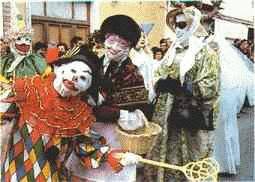
On the day of the Holy Innocents Els Enfarinats (men with flour-caked faces) go through the streets of Ibi (Alicante), with their duly chosen mayor, who assumes municipal power for the day. These flour-caked figures dress in a slovenly manner and go around the banks and shops imposing fines. In the evening Els Tapats -unrecognizable masked figures- make an appearance. Later the frank and
biting bands of els enfarinats, criticising local people and institutions, are read out. Similarly, in Campo de Mirra (Alicante), there are sometimes "Fools" Festivals at Christmas time, where people disguise themselves and go through the streets satirizing life in their town. Julio Caro Baroja, in his novel El Carnaval (Carnival), compares this type of festivity with the Roman
Saturnalia, which used to be held around this date, saying: but the traditional day for electing Kings, Mayors, etc., is the day of the Holy Innocents. The traditional jokes played on such a day also took place in Rome during the Saturnalia.
The Old Year is seen out with pines and bonfires, and many such activities extend into the New Year which is symbolic of regeneration and a fresh start. Centelles (Barcelona) stages a Pinewood Festival in honour of the martyred St Coloma, burnt at the stake with pinewood. At down on 30th December els galejadors or trabucaires (gallants or musketeers, respectively) deafen listeners
firing their popguns, the noise of which dominates the whole festival. People then proceed to the mountain to collect the pine tree, the focal point of the celebration. Once in teh village, the tree is raised in the square, dancing takes place, and then the tree is carried inside the church. Here
it is laid flat on the floor and the top is decorated with waters and five branches of apples. On 6th January its branches are distributed amongst the townsfolk.
The Fiesta de la Carreta (Cart Festival) takes place in Cogollos de Guadix (Granada) from 30th December to 1st January. The 30th is known as firewood day where the village youths collect firewood and fell a pine tree. On the 31st, cart-day the girls decorate the tree, which is carried to the town, blessed and shared out. In the evening there is a children's procession for
the Child Jesus, and at night a huge bonfire, around which the whole town is congregated. On 1st January, the Infant Jesus's Day, his statue is carried in procession to the church.
In Huesa (Jaén), the castillos del Santo (the Saint's castles) are burnt using pine torches, surrounded by dancing, singing youths, some of whom leap across the live coals. The cargos de San Silvestre (St Sylvester faction) fly their colours to the beat of the drum.
Andrés Pardo, in the article on the origins of Christmas referred to above, points out that the 6thh January was devoted to the celebration of the winter solstice by the Egyptians and the Arabs. The
gnostic sect christianized this pagan festival in honour of the sun around 120-140
Our inherited tradition is to have 6th January as the Epiphany (or Day of the three Kings as it is known in Spanish). Celebrations take two fundamental forms: one, more ancient, which is the Play of the three Magi (known under various similar names in Spanish), and another, relatively recent, which is the
mounted procession.
Plays are currently staged in, amongst other places, Aledo (Murcia), Cañada (Alicante), Churra (Murcia), Sangüesa (Navarra), Santillana del Mar (Cantabria) and Viso de los Pedroches(Córdoba), this latter one not taken place every year.
With respect to mounted processions, Adrián Espí, a chronicler from Alcoy, had it that they first started in his town in 1885. Since then, excepting the civil war years, it has been held every year. In Seville, it was held for the first time in 1916 under the auspices of the Ateneum,
and was copied the following year in Higuera de la Sierra (Huelva).
 Spanish Fiestas

 Back to Spanish Fiestas