Behind most of these traditional celebrations which take place on the last day of April and the first few days of May,
there is an exaltation of love and nature reborn, with songs describing the fertile land which will soon yield its
harvests. The influence of Christianity on ancient rituals has brought the inclusion of statues of the Virgin Mary
(for example in the mayos songs) and the cross, and many of these celebrations are now dedicated to these symbols.
The mayos usually take place on the night of April 30th, and their themes are mainly descriptive and related to
love, one of most well-known verses being the following:
The last day of April is at a close
tomorrow we welcome the month of May
beautiful and bursting with flowers
although the lyrics vary considerably from one region to another. This is a typical custom in the region of Castile-La Mancha
more than any other: first the mayos are offered to the Virgin Mary and then all the male participants parade in front of the young
single girls or go to their houses where a cross has been dressed, ie., adorned. This continues for the first few days of May although
there are places where it lasts for a whole month.
The term mayos also refers to the frames made in different parts of Galicia which are usually conical or in the shape of a cross and are
adorned with fruit and vegetables. In Orense, Pontevedra, Villagarcía de Arosa (Pontevedra) and other places, competitions
are held in which young men take part, having to go round and round the maio, singing satirical songs whilst they strike the ground with a stick.
Another important date is the 3rd of the month, when an integral part of the festival takes place: the exaltation of the Holy Cross. Crosses are decorated and
usually placed in the houses where for a whole month they dominate not only family life but also that of the whole village. Some of these crosses are magnificent
works of art, not to mention patience and they are made by the women of the household, who, helped by friends and neighbours, dress the cross, taking
several months to complete the task and using all their savings. Families sing, eat and pray and dance around their cross, exchanging advice and experiences
which are handed down from generation to generation. The towns and villages of Andalusia and Castile-La Mancha in particular are famed for this
type of long-established ritual in the household. In Córdoba, the festival of patios and May crosses competition are held in the first fortnight of May.
Inspired by the giving of the Holy Cross to Santa Elena, popular plays are put on in Corte de Peleas and Feria, both in the province of Badajoz.
In Feria, this tradition was revived some years ago and the most important features are the serious heartfelt songs sung by choirs describing the outline of the play in progress.
The eucharistic play of the Sacrifice of Isaac is also performed in Laza (Orense) although perhaps the most interesting part of the festival is when the
mayo is collected by the young men of the village on the eve of the Holy Cross. The mayo which must be the tallest and straightest tree in the area as well as
having beautifully neat foliage, is planted in many places in Spain and it signifies the heart of both these spring-time festivals and others which are held on different
dates but which include the tree. In Laza, on May 2nd, the young men kidnap the girl who has been chosen to play the role of Eve, so that nobody knows who she is, and on
the following day, the dancers and whoever is playing Adam have to find her, whith everybody joining in the procession.
Another widespread activity around these dates are festive pilgrimages during which the fields and the water which irrigates them are blessed, and a crucifix or statue
placed on some sites. The feasts of San Miguel (8th) and San Isidro (15th) are celebrated in this way with pilgrimages to the countryside, competitions, games, dances
and meals, although many of these have been moved to the nearest weekend to the saints' days.
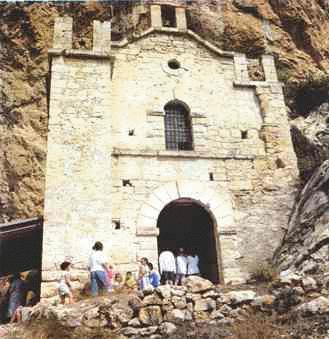
In Castellote (Teruel), the men of the town make a pilgrimage to the hermitage of Llovedor on 1st May. The origin of this dates to 1408 when twelve men from the
village went to Zorita del Maestrazgo (Castellón) to beg the Virgen de la Balma for rain. (This virgin is believed to possess many different powers,
including the power to exorcise those possessed by the devil.)
Antoher pilgrimage, which is obviously an act of penitence, begins on the night of 30th April in Tafalla (Navarre), and is led by the Twelve Apostles, wearing robes
with black hoods, a belt made of string around their waists, and carrying lanterns. They make their way to the shrine of Nuestra Señorade Ujué, covering the distance
of 17 km on foot. There are many other pilgrimages to this shrine, although most of these have now lost their significance as acts of penitence.
Before the end of the month, on 19th May (but not every year), Cetina (Zaragoza) is the home of the contradanza, which is unique to Aragón and in which eight men
and the devil himself take part; in the morning there is a dance in honour of San Juan Lorenzo which is presented by eight children, a shepherd boy and a head shepherd.
In Huete (Cuenca) there is an interesting celebration which is a clear throwback to the times when the main focus of attention was rivalry and confrontation between different
areas and neighbouring villages. The inhabitants are divided into two groups -juanistas; who are honouring their patron saint, San Juan, the weekend following 6th May, and
quiterios who pay homage to Santa Quiteria the weekend following 22nd May. Although both celebrations are of a very similar nature, eg., both include the dance of the galopeos,
it is clear that the rivalry between them is taken very seriously indeed, to such an extent that until very recently the marriage of a juanista to a quiterio or vice-versa
was virtually unthinkable.
Also in this month, there are a number of celebrations in which women are the main participans, such as the Virgen de la Paz in Mazuecos (Guadalajara), the procession of holy bread
in Torremanzanas (Alicante), Santa Quiteria in Fuente el Fresno (Ciudad Real) which includes four chief female characters and the procession of the hundred maidens in Sorzano (Rioja).
 Spanish Fiestas

 Back to Spanish Fiestas