At he present time the coming of the Holy Spirit is commemorated by the Curch at Whitsuntide, which is fifty days after the Resurrection. Its origin
however is to be found in the Jewish celebration in memory of the Law which was given to the faithful by Do on Mount Sinai and which takes place fifty
days after the Lamb of God.
On this date, in the town of El Rocío, in the region of Huelva, the pilgrimage par exellence takes place in which thousands of people take part,
whether it be as active participants or as mere spectators. El Rocío has two distinct parts to it: the journey, which is made on foot, horseback, or carriages
by the rocieros who always take part, and who are members of brotherhoods, crossing the fields of Andalusia; and the celebration in the town itself in which
the Blanca Paloma is honoured. The only people to take part in the most solemn celebration are the inhabitants of Almonte (the most important brotherhood,
Hermandad Matriz, is from Almonte) who have the privilege of bringing out the Virgen del Rocío, carrying and parading her for several hours amid the
dust, sweat, and more than a few tears from the faithful.
The caballada in Atienza (Guadalajara) is celebrated on Whit Sunday, although the preparations are made the day before, called día de las siete
tortillas, when the head steward, ruling body and committee of the brotherhood make their way to the hermitage of La Estrella. The caballada celebrates the feat
of the group of muleteers from Atienza who in 1162 saved Alfonso VIII, who was a child at the time, from his uncle Fernando II who had besieged the town.
The celebration of Whitsuntide (also known as Pascua Granada) is widespread in Spain, but especially in Catalonia, where a number of aplecs, or pilgrimages
are undertaken, and also an interesting Festa Major (main festival) in Sant Feliu de Pallerols in the region of Girona.
On Monday after Whit Sunday Navarre witnesses several rogation processions attended by the respective villages, with their dignitaries at their head. In Huéscar
(Granada) the traditional pilgrimage of Saints Alodia and Numilón is held, and to the cry of the blessed saints into the water (al agua santas benditas) the
faithful step into the water, barefoot, and as a sign of their faith holding the statues of the saints.
Among the people of Peñas de San Pedro, the pilgrimage of Cristo Sahúco is traditional, which consists in carrying upon their shoulders at great speed
a kind of coffin, in the shape of a cross, and within which the figure of Christ is placed; on 28th August the return journey is made in the same way, leaving the village and
going as far as the shrine, which is a distance of 15 kms.
The following Sunday, called Trinity Sunday, the crossbearers of Lumbier (Navarre) begin their pilgrimage to the hermitage of the Holy Trinity (Santísima Trinidad) which is
situated at the top of a nearby mountain. The tradition of the crossbearers, previously widespread throughout Navarre, is thus preserved by these penitents, who wear black
robes and pointed hoods, many of them going barefoot and laden down with heavy crosses as a sign of their penitence.

 Spanish Fiestas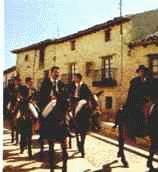

 Back to Spanish Fiestas