Further bonfires are lit in Mallorca for the feast of St Stephen on 20th January. However, this feast-day features particularly unusual and
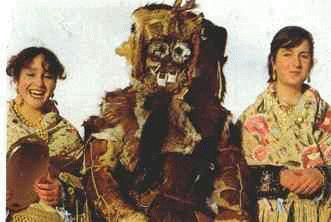
interesting displays, such as that of the Acehúche (Cáceres) carantoña (ugly mugs) men disguised in animal skins
and covered by horrible masks who bow before a statue of St Stephen in the procession. In Navaconcejo (Cáceres) the taraballo
(type of bogeyman), dressed in white, woolen cloth and armed with a dampened rope whip, chases after youths during the processions, and in
Piornal (Cáceres) the jarramplas (vociferous character shouting absurdities) can be seen. This grotesque, masked figure, dressed
in a brightly coloured costume, is pursued and violently pelted with turnips. The Robo del Santo (stealing of the Saint) in Caniles (Granada)
appears to date back to the 18th century; groups of youths take part, staging a positive pitched battle. This same day sees the Bael del Bó-Bó (Bo-Bo dance)
performed in Monistrol de Montserrat, whilst L'Estandart (Standard-bearer) and Els Cavallets (Small Horses) are the most
traditional features of the celebrations in Pollença (Mallorca).
In Rajadell (Barcelona) the Baile de la Coca (Cake dance) is held on the nearest Sunday to the feast-day, and Villaviciosa de Odón (Madrid)
stages a Rondón dance. During the procession for the Saint in Coria (Cáceres), sweets are thrown for the children, and in
Portezuelo (Cáceres) the statues of St Fabian and St Stephen are carried inside each house. On the eve and actual Saint's Day, the city of
San Sebastián (named after the Saint) stages its spectacular Tamborrada (mass drumroll) in which many associations take part.
Lastly, there is the Pelegrí de Tossa (Tossa pilgrimage) between Tossa de Mar and Santa Coloma de Farners (Gerona), to comply
with the traditional vow established by the townsfolk in the 14th century.
Sebastián (Stephen), chief captain of the Diocletian guard, was a fervent defender of the faith and offered spirited consolation to countless Christian
martyrs in their most difficult hour. On discovering this the Emperor wished to punish what he considered as a betrayal and ordered that Sebastián be tied
to a tree and shot dead by archers. Miraculously he survived this ordeal, but was killed and thus martyred on 20th January, 228 by the public beating he received.
On 25th January, the feast of St Paul, San Pablo de los Montes is the scene for a celebration in which youths who have completed their military service that year
play the main part. They bunch together in a so-called cow comprised of the Mother Sow, the Cow, the Sweep and the cowbell-ringers. The cow runs
round the town, disrupts the procession and trots in a bizarre manner to the doors of the Town Hall where toast and lemonade are served to them.
Meanwhile, the Mother Sow goes about lifting women's skirts up, revealing its own numerous underskirts at the same time.
The yoariak or zanpanzarrak in Iturren and Zubieta (Navarre) perform their annual ritual of good township neighbourliness on the Monday
and Tuesday after the last Sunday in January. Dressed in white petticoats over blue trousers, sandals, and sheepskins, all topped by a cone-shaped, multi-coloured
cap called a tunturro, they go from one place to another noisily but rhytmically sounding the enormous cowbells strapped to their backs, brandishing a small
broom, or hisopua as it is known.
On the same Sunday in Guarrate (Zamora), the conscripts let cocks loose in the streets. The youths, on horseback and dressed in military uniforms, firstly
state their family situation, making what is often fierce self-criticism but from which the closest family members are not saved, either. Their own faults are
then attributed to the cock, which suffers a fate befitting its sins: armed with a sabre, the youths strike a forceful blow at the animal, although they rarely manage to decapitate it.
 Spanish Fiestas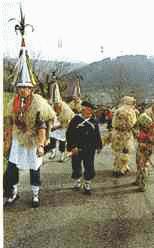

 Back to Spanish Fiestas