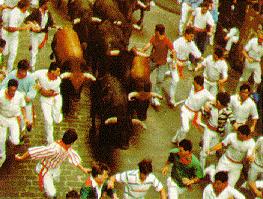
The term San Fermín has come to mean... Pamplona; bulls and bullrunning, wine groups of people united in one aim, drowsy Americans
wandering around searching for the ghosts of their unknown predecessors, and people out on the streets at all hours of the day and night. In a word... Fiesta.
San Fermín is also celebrated in another place in Navarre, Lesaca, where interesting dances are held, the most important being called zubigaineko,
a typical dance which takes place on the banks of the river Onín which, in time goneby, marked the boundary between two rival areas of the town who had a great
deal of confrontations on this site.
San Fermín, bishop and martyr of Pamplona, preached for many years throughout Navarre, later crossing the Pyrenees to continue his evangelical work. He died and was
buried in Amiens --the body then disappeared and was miraculously found six centuries later and although it was mid-winter, it is said that the trees burst into leaf and the
fields were green again.
The people of La Laguna (Tenerife) give thanks to San Benito for his miraculous intervention to end the drought which was affecting the area in 1532, with a pilgrimage
that takes place on the first Sunday in July. On the morning of the first Saturday of July, the locals transport the statue of the Virgen de los Reyes from its hermitage to the
capital, Valverde del Hierro. They spend the entire day walking through hills and vales, crossing the island from one side to the other. The return journey is undertaken
four weeks later, in fulfillment of a promise made to the Virgin in 1745 and which is repeated every four years. The last pilgrimage was made in 1989. On the 11th of this month,
the feast day of the saint, there are guild dances in his honour in Allariz (Orense) and the sword dance (with the patatú, during which the execution of
the chief is represented) in Obejo (Córdoba). Pilgrimages are also held with ex-voto and offerings in Cambados (Pontevedra), Padrón (La Coruña),
Porriño (Pontevedra) and other places in Galicia. In Pontevedra, adorned boats cross the river Lérez to pay homage to San Benitiño.
On 13th July, in Roncal (Navarre) is the Tribute of the three cows in which the mayors of the Roncal valley and Baretous valley in France take part, the latter
handing over three cows to the former in accordance with an agreement dating back to 1375 which ended all hostilities between the people of the two valleys.
Boats adorned with flags and pennants take to the sea again on 16th July to celebrate the feast of their patron saint, Virgen del Carmen.
In Cangas de Narcea (Asturias), the Society of Craftsmen fire a magnificent volley of shots just as the saint reaches the bridge. In
Molina de Aragón (Guadalajara) there is an impressive procession of the brotherhood, whilst in Olot (Girona) the drac
(dragon) and conill (rabbit) take part. The sailors of Puerto de la Cruz (Tenerife) carry their patron saint in a procession which
sways its way from the church to the quayside, and in Avilés, Mieres and Pola de Siero (Asturias) the danza prima takes place.
Mary Magdalene, whose ease of manner was a little more than is necessary with certain ways about her a little freer than modesty allows, and in spite of her
slatternly life, was inmediately converted on hearing Jesus and thence became one of his most fervent followers. On her feast day, 22nd July, the dancers of Anguiano (La Rioja)
descend the steps of the church on stilts and then sprint down the hill in one of the most fascinating and original demonstrations in Spanish folklore. On the last Sunday in September,
the dancers accompany her on the return journey to the shrine, this time going up the cobbled slope. In honour of La Magdalena, there are numerous other kinds of celebrations in
other parts of Spain, but especially in Navarre, Asturias and the Basque Country.
 Spanish Fiestas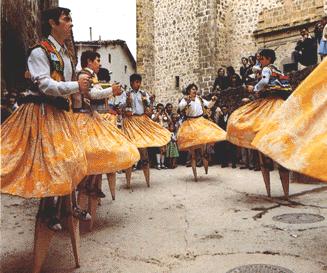

 Back to Spanish Fiestas